

Before cocoa reaches Europe
When cocoa sales depend on identifying producers, mapping plots and recording transactions, compliance becomes practical work throughout the first mile of the supply chain.
Digital traceability and compliance work in Côte d’Ivoire
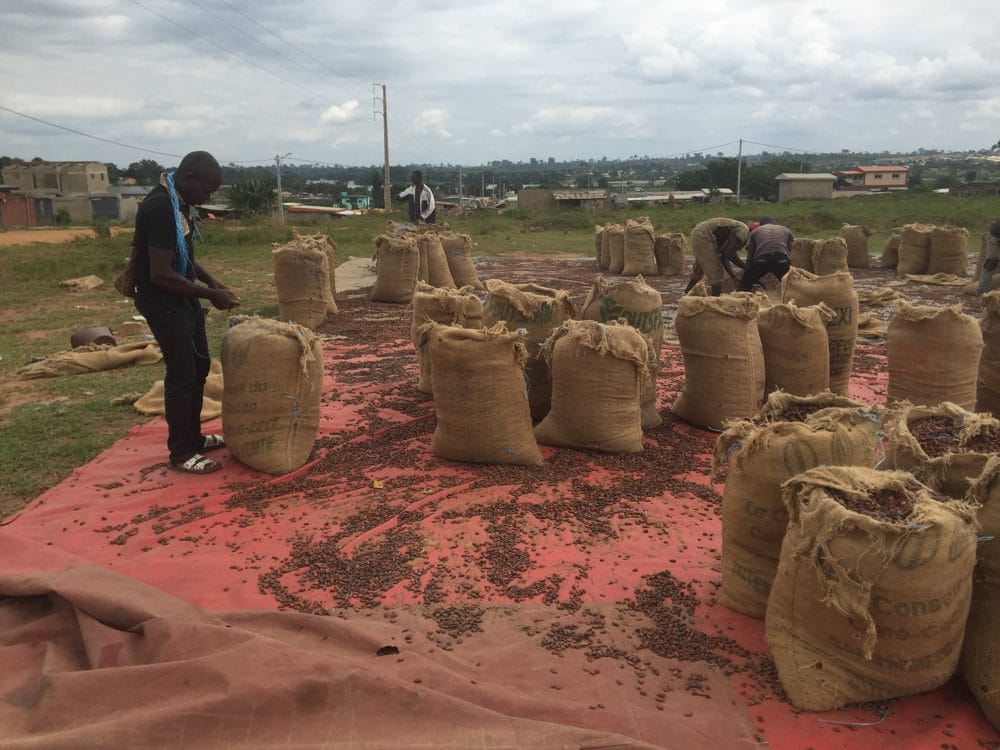

Since 1 September 2026, Côte d’Ivoire’s national traceability system has required a producer card for coffee and cocoa transactions and channelled payments through electronic terminals. During the first weeks of the rollout, Reuters reported that some cooperatives and purchasing agents lacked the terminals they needed, that certain traceability materials were unavailable, and that some users were unfamiliar with the new digital tools. Meanwhile, Ivorian institutional sources have indicated that transitional arrangements are in place for producers who do not yet have a card.
The news can easily be read as the local effect of a European regulation. On 30 December 2026, the European Union will begin applying the EU Deforestation Regulation, or EUDR, to large and medium-sized operators. Cocoa is among the commodities it covers. But that reading is incomplete.
The Ivorian card was not created in September 2026, nor is it simply a device imposed from Brussels. Côte d’Ivoire had begun registering producers and plots, distributing cards, and building a national traceability system years earlier. A decree dated 13 September 2023 formally established the Système national de Traçabilité du Café-Cacao. Moreover, the card does more than demonstrate the origin of cocoa: it identifies the producer and forms part of a system that also seeks to secure transactions and ensure payment of the guaranteed farm-gate price.
This changes the question. Rather than asking whether Europe is “digitizing” Ivorian cocoa, we should examine what happens when a global trading chain requires the product to travel with increasingly precise information.
Who is required to do what?
The EUDR requires covered products not to come from land deforested after 31 December 2020, to have been produced in accordance with the applicable legislation of the country of origin, and to meet the relevant due diligence obligations. Plot geolocation is a central piece of information in the system.
But this does not mean that every smallholder cocoa farmer in Côte d’Ivoire must personally submit a statement to the European Union. The European Commission itself specifies that a producer outside the EU who sells cocoa to a cooperative or company in their own country is not, by that act alone, placing the product directly on the European market.
The distinction matters. Who is legally responsible for complying with the Regulation is one question; who must do the practical work that makes compliance possible is another.
A plot’s geolocation does not appear spontaneously when a sack reaches a European port. Someone must first have identified the producer and linked the production to the correct plot; someone must record the purchase; someone must maintain the link between the physical product and that information as the cocoa moves through cooperatives, intermediaries, exporters, and processors.
We can call this set of tasks compliance work: not as a legal category, but as a way of describing the practical and administrative work that turns a regulatory requirement into a verifiable chain.
The first mile
The literature on global value chains refers to the first mile: the point at which smallholders enter the trading chain.
In Ivorian cocoa, this first mile was already extensively regulated before the new digital traceability system. Kathrin Kaestner, Gunther Bensch, and Colin Vance show that Côte d’Ivoire has a highly institutionalized system of price formation and marketing, with the Conseil du Café-Cacao involved from the producer through to the export port.
Digitization is therefore not entering a rural market without institutions. It adds to an existing architecture of prices, buyers, cooperatives, transport, exports, and regulation.
The new system introduces another layer: digital information that must accompany the product as it moves.
According to Ivorian institutional sources, producer cards, electronic payment terminals, and mechanisms for sealing or identifying sacks are all part of this system. It must be possible to link producer, plot, transaction, and product.
This capability may offer benefits that should not be overlooked. The Ivorian government presents electronic payment as a way to reduce the movement of cash and its associated risks, and to strengthen adherence to the guaranteed price. Traceability may also help Ivorian cocoa retain access to markets that require more detailed environmental information.
But infrastructure is useful only if it works where it is needed.
When the terminal does not arrive
The problems reported in September cannot be treated as a complete account of the rollout. In early October, officials of the Conseil du Café-Cacao described uneven adoption in the Daloa region, while the distribution of producer cards was still under way in Nawa. These reports do not establish that the system is excluding producers on a large scale or causing a widespread fall in incomes. Nor do they establish that the initial technical and logistical difficulties have been resolved everywhere.
That caution does not make the problems irrelevant.
If a commercial transaction depends on cards, terminals, and accurate records, a technical or logistical problem is no longer merely an IT inconvenience. It can become a commercial problem, even if transitional measures can temporarily soften its impact.
This is where global regulation takes a very concrete material form: a terminal that has not arrived, a person who does not yet know how to use it, an incorrectly linked plot, or a record that cannot be validated.
This does not demonstrate that digitization generates inequality. It does indicate where to look for it, should it emerge: in the uneven distribution of the capacity to produce the information the market requires.
Cooperatives as mediators
Cooperatives may play a central role in this process.
A study by Hamza Moluh Njoya and colleagues, based on farmers in western Côte d’Ivoire, finds that cooperative members have a better understanding of EUDR requirements than non-members. They also tend to have greater access to training, agricultural extension services, and credit.
The researchers stress, however, that knowing about a regulation does not necessarily mean being able to comply with it.
This distinction is particularly relevant now. A cooperative can pass on information, organize purchases, provide equipment, or centralize administrative tasks that an individual producer would find harder to undertake. It can thus become an infrastructure of mediation between the plot and the demands of the global market.
But this also raises the question of what happens to producers with less organizational support. We do not yet have sufficient data from the 2026 rollout to say that they are being left behind. This is a hypothesis to be tested, not a conclusion.
Formalization also changes relationships
Traceability is part of a broader process of formalizing agricultural trade.
In research on Côte d’Ivoire and Ghana, Sophia Carodenuto and colleagues show that more formal contractual relationships can provide services and a clearer structure, but can also reduce flexibility in the choice of buyers and alter power relations at the first point of sale.
This observation does not establish that the electronic card produces those same effects. But it helps frame a relevant anthropological question: when a transaction comes to require more records, identifiers, and procedures, more than the amount of available information may change. Who can act as an intermediary, who can validate a transaction, and what alternatives each actor has may also change.
From an anthropological perspective, this translation is the point of interest: a transnational rule becomes local practice through cards, terminals, cooperatives, records, and purchasing routines. In this sense, traceability is not just a technology for tracking a sack of cocoa. It is also a way of organizing relationships between producers, cooperatives, buyers, public authorities, and markets.
A European regulation that needs information produced outside Europe
The EUDR aims to reduce the contribution of European consumption to deforestation. But its implementation reveals a feature of many transnational regulations: a rule may be adopted in one place while some of the information needed to make it effective must be produced elsewhere along the chain.
Côte d’Ivoire is not a passive recipient of this process. Its traceability system has a history, objectives of its own, and a state institutional architecture that predates the application of the EUDR. The government also seeks to protect Ivorian cocoa’s access to international markets and strengthen the sustainability of the sector.
This is precisely what makes the case more interesting than a simple story of external imposition.
European regulation and Ivorian policy converge on one point: both require the origin of cocoa to be legible.
The question is how that legibility is produced.
Every geographical coordinate, every producer identifier, and every recorded transaction requires equipment, staff, training, maintenance, and institutions capable of resolving errors. Compliance is not just a rule. It is also an infrastructure.
More than tracking a sack
Further evidence will be needed to determine whether the initial difficulties in the Ivorian system were simply those of a technological rollout or whether they reveal more persistent inequalities between territories, cooperatives, and producers.
The evidence reviewed here does not yet establish that answer.
It does, however, reveal a broader transformation. In a chain regulated by environmental criteria, selling no longer consists only of producing and transporting a commodity. It also requires the production of a verifiable account of that commodity: who grew it, where, and how it entered the chain.
This digital account may offer greater transparency, facilitate payments, and help distinguish cocoa that meets the new rules.
But it has a material cost: someone has to build it.
That is why, before cocoa reaches Europe, a decisive part of compliance has already taken place far from the European border, in the first mile of the chain.
Main sources
Agence Ivoirienne de Presse. (2026, 23 August). Filière café-cacao : la carte du producteur obligatoire pour les transactions dès le 1er septembre 2026.
Reuters. (2026, 9 September). Ivory Coast cocoa sellers struggle to use new traceability system.
Agence Ivoirienne de Presse. (2026, 4 October). Le Conseil du Café-Cacao appelle la délégation de Daloa à accélérer le déploiement du système national de traçabilité.
Agence Ivoirienne de Presse. (2026, 7 October). Café-cacao : 12 346 cartes de producteurs restent à distribuer dans la Nawa.
Gouvernement de Côte d’Ivoire. (2023, 13 September). Decree establishing the Système national de Traçabilité du Café-Cacao.
European Commission. (2026). Roles and responsibilities under the EU Deforestation Regulation.
European Commission. (2026). EU Deforestation Regulation (EUDR).
Hamza Moluh Njoya, Sofía Cristóbal Reyes, Koumbo Alberic Hien, Franziska Ollendorf, Bonna Antoinette Tokou, Constant Yves Adou Yao, Stefan Sieber, & Katharina Löhr. (2025). Can cooperative membership foster compliance with New European Union regulations on deforestation-free production? Evidence from cocoa farmers in Western Côte d’Ivoire. Trees, Forests and People, 20, 100897. https://doi.org/10.1016/j.tfp.2025.100897
Sophia Carodenuto, Claire Cutler, Sokhna Dieng, Marshall A. Adams, & William Thompson. (2025). Formalization through contracts: Implications for power in smallholder cocoa supply chains. Geoforum, 164, 104323. https://doi.org/10.1016/j.geoforum.2025.104323
Kathrin Kaestner, Gunther Bensch, & Colin Vance. (2026). Pass-Through of Cocoa Prices Along the Supply Chain: What’s Left for Farmers in Côte d’Ivoire? Journal of Agricultural Economics, 77(2), 411–428. https://doi.org/10.1111/1477-9552.70021